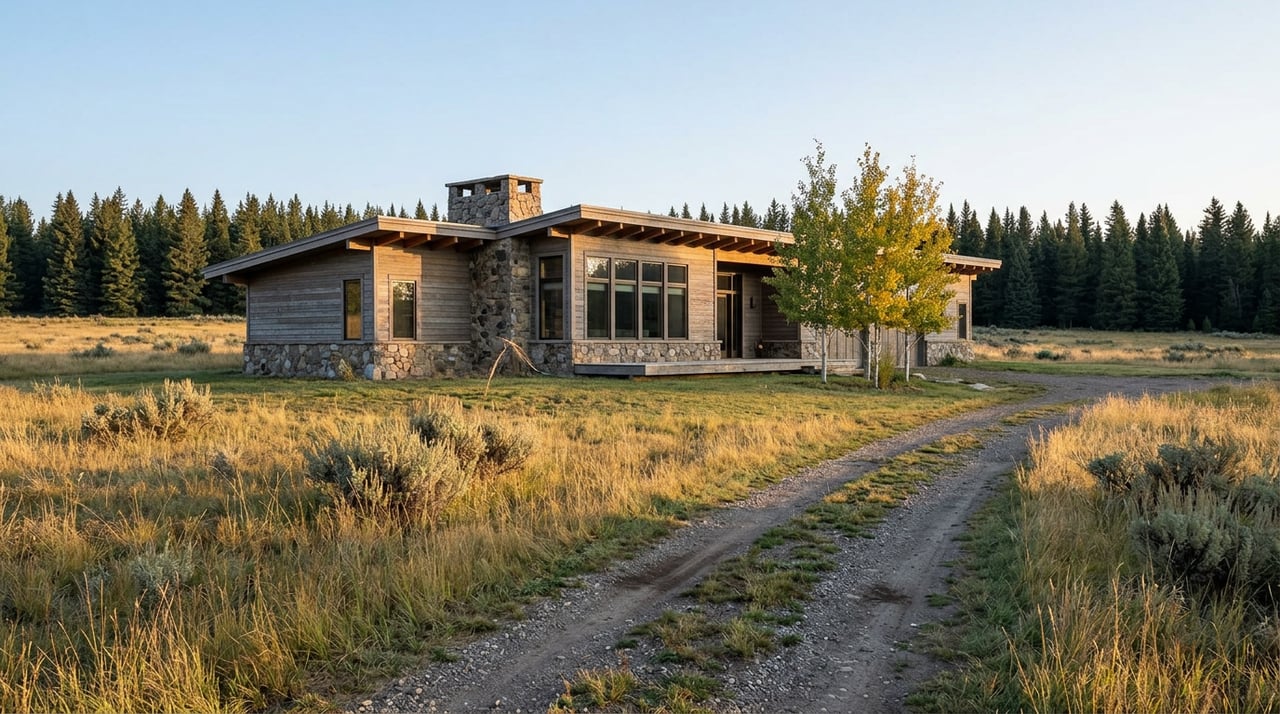
In the spring of 2015, Teton County commissioners sat through a hearing about whether the Resor family could host a handful of weddings a year on Snake River Ranch. Neighbors worried about noise. The family argued they needed a way to keep the ranch solvent. Commissioner Mark Newcomb made an observation that surprised almost everyone in the room: despite the conservation easement already on the property, the family could still build up to 55 new residences across the ranch's 1,300 acres if they chose to. The easement protected the open space. It did not erase the entitlement.
That distinction matters again this year, because the chapter that easement was part of just closed for good.
The last parcel is gone
In July 2026, Grand Teton National Park completed the sixth and final transfer of private Snake River Ranch land into public ownership, adding roughly 210 acres near the Moose-Wilson Road entrance, right against Jackson Hole Mountain Resort's Saratoga Bowl. The deal was reported by KHOL, which noted the park had been working with the Resor family and The Conservation Fund since 2001 to retire these inholdings one at a time. The Great American Outdoors Act, passed in 2020, helped fund the final push, and roughly $35 million in Land and Water Conservation Fund money moved through this specific corridor over 25 years to get it done.
If you have spent any time researching land north of Jackson, you have probably absorbed the general shape of that story already: national park buys ranch land, land gets protected, everyone is happy. What most coverage does not spell out is what it means for the private parcels that remain.
Dan Schlager, The Conservation Fund's Wyoming state director, said something worth sitting with when the deal closed. Parcels that had been the most at risk for development, he said, are now protected, leaving just a few potential areas for similar land exchanges. That is not a hopeful forecast. It is closer to an obituary for a specific kind of opportunity. For 25 years, buyers and neighbors north of Jackson could reasonably assume more Snake River Ranch acreage might eventually come off the table and into public hands, reshaping the boundary and the view corridor around it. That assumption no longer holds. The corridor near Moose-Wilson Road is essentially finished being renegotiated.
What "at risk" was actually worth
Months before that final transfer closed, the park paid $10,995,000 for a separate 35-acre parcel near Granite Canyon, east of Saratoga Bowl and north-northwest of the ranch's remaining lands. The deed was filed with Teton County in March 2026 and reported by the Wyoming Tribune Eagle. Do the arithmetic and that works out to roughly $314,000 per acre, a number GearJunkie highlighted as one of the steepest per-acre prices the park has paid to retire private inholdings.
That number is not a market comp in the way a home sale is a comp. The park was not competing against other buyers at an open listing. It was paying what it took to permanently retire land that Schlager described as facing extreme development threat given its topography and proximity to the resort boundary. Public conservation dollars, funded through offshore energy royalties rather than private capital, do not behave like a typical buyer's budget. What the price does tell you is how the government itself was pricing risk on that specific stretch of ground. If a 35-acre parcel with prime wildlife habitat and open Teton views commanded that kind of premium to keep it undeveloped, the private acreage still sitting just outside the new park boundary, in places like Solitude Subdivision, Teton Cascades, and Grand Teton Meadows, is sitting closer to that ceiling than most buyers realize.
The easement question you actually need to ask
Here is where the 2015 hearing becomes relevant again. A listing description that mentions a conservation easement, or borders land recently added to the park, can read like a guarantee of permanent, unchanging privacy. Sometimes it is. Sometimes it is not.
The Snake River Ranch case is instructive precisely because it shows both outcomes on the same property. Some acreage went into full public ownership through the park transfers, permanently closed to any future construction. Other acreage on the working ranch kept a conservation easement that still allowed a defined number of new homes, because the easement was written to protect open space and agricultural use, not to zero out every future building right. Two pieces of land, both described publicly as "conserved," with very different ceilings on what can still be built.
Before you treat a nearby conservation easement as a permanent feature of your view or your privacy, it is worth finding out three things:
- Whether the easement is held by a public agency, a land trust, or a private conservation buyer, and what that entity's enforcement history looks like
- Whether the easement document retains any specific number of allowed residences, ancillary structures, or event use, the way Snake River Ranch's did
- Whether the easement can be modified, and under what conditions, since some agricultural easements are written with more flexibility than a full fee-simple park purchase
None of this is a reason to walk away from land near conserved acreage. It is a reason to ask for the actual recorded document rather than relying on how a listing summarizes it.
What the broader numbers are saying
Zoom out to the county level and the pattern lines up with what happened north of Jackson specifically. Quarterly data compiled from Teton County MLS activity for the first quarter of 2026 showed land sales rising year over year even as overall transaction volume softened, a shift attributed in part to buyers accepting that custom construction, however slow, remains more available than finding an existing home that fits. One local market summary from that period put it plainly: they are not making any more land. That is not a marketing line here. It is closer to a literal description of what just happened along Moose-Wilson Road, where a specific, named, decades-long supply of large private parcels has now been reduced to whatever remains outside the new park boundary.
For a buyer comparing North of Jackson to other parts of the valley, that context reframes the math. The question is not whether this area still has undeveloped land available. It does, and homesites in Solitude Subdivision, Bear Island, and Grand Teton Meadows continue to trade. The question is whether you are buying into a supply that is still being shaped by ongoing negotiations, or into a supply that has, in this particular corridor, just had its last major variable removed. As of this fall, it is the latter.
What this changes if you are actually shopping
If you are looking at acreage north of Jackson right now, three practical shifts follow from everything above. First, do not price in the expectation that more Snake River Ranch land might come onto the open market later. That pipeline, per The Conservation Fund's own assessment, is close to exhausted. Second, treat any comparison to the Granite Canyon purchase price with caution. It reflects what a public agency paid to eliminate development risk entirely, not what a private buyer would pay for a home site with an easement already in place. Third, request the recorded easement language on any property near the new park boundary before you assume its neighboring buffer is permanent. The Snake River Ranch story proves that "protected" and "undevelopable" are not always the same word.
FAQ
Does a conservation easement mean a property near it can never be developed? Not automatically. Easement terms vary. Some retire all development rights, as happened with the parcels transferred into Grand Teton National Park. Others, like portions of Snake River Ranch's working acreage, were written to allow a specific number of future residences while still protecting open space and agricultural use. Always ask for the recorded terms, not the listing summary.
Does land next to newly added park acreage cost more? It can, but the comparison is not direct. The $314,000 per acre the park paid near Granite Canyon reflects a public agency retiring development risk permanently, funded through dedicated conservation revenue. Private buyers are pricing something different: proximity, view corridor, and access, not the elimination of a development right.
Is the newly transferred Snake River Ranch land open to the public now? Once acreage transfers into Grand Teton National Park, it becomes part of the park's public land base, managed under NPS rules like the rest of the park. Specific access points and any trail development typically follow park planning processes rather than an immediate opening.
Land north of Jackson does not get simpler to read from a listing sheet, and this year's news makes that more true, not less. If you are trying to figure out what a specific parcel's easement actually allows, or how a property compares to what just changed along Moose-Wilson Road, Mountain Group has spent decades tracking exactly this kind of local detail. Let's make our hometown yours. Request a consultation and we will walk the record with you before you write an offer.