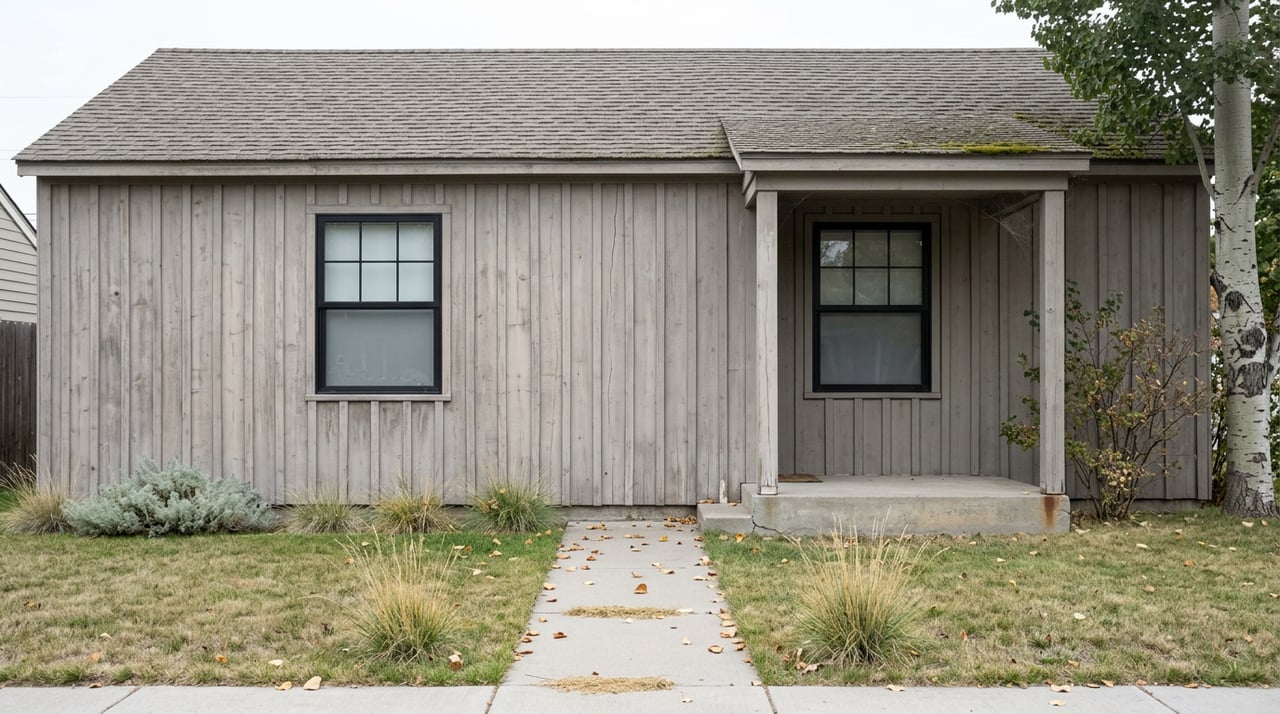
In the summer of 2025, a planning department filing crossed a desk at a Jackson title company for a modest two-bedroom cottage on East Simpson Avenue. The owner wanted the flexibility to rent the place out during the weeks they weren't using it themselves. Nothing unusual about that. Half the listings in Town of Jackson these days mention some version of "rental income potential" in the marketing copy.
What the filing revealed, though, is the part most buyers never think to ask about: whether that potential actually belongs to the house, or just to the person who happens to own it this year.
The answer depends on which side of an invisible line the property sits.
Two towns, one map
The Town of Jackson runs two entirely different short-term rental systems under the same municipal roof. One lives inside the Lodging Overlay and Planned Resort Zone, the downtown core and Snow King Resort. The other covers everything else, the ordinary residential neighborhoods where most people actually live: NL-1 through NL-5, NM-1, NM-2, NH-1, R, MHP, and OR zoning.
Inside the overlay, a short-term rental permit is close to a permanent fixture. Once the Town approves a Basic Use Permit, it doesn't need to be renewed every year, and when the property sells, the Town's own STR guidance confirms the new owner doesn't need a new BUP at all. They just pick up a business license and keep going.
Outside the overlay, none of that carries over. The BUP has to be reapplied for and reapproved every single year the STR operates, and that requirement doesn't reset or pause when a deed changes hands. The same page spells it out plainly: outside the Lodging Overlay, an initial BUP and annual renewal are both required, and neighbor notification within 200 feet has to happen every year of operation, not just once at setup.
Here's the comparison side by side:
| Inside Lodging Overlay / Resort Zone | Outside Overlay (ordinary residential) | |
|---|---|---|
| BUP renewal | Not required annually | Required every year |
| Survives a sale | Yes, new owner needs only a business license | No, treated as new each year regardless of owner |
| Neighbor notification | Not required | Required annually, 200-foot radius |
| HOA notification | Not addressed the same way | Proof of notification required before BUP is issued |
| Rental caps | None specified in this program | 3 stays and 60 total nights per calendar year, per unit |
| Violation penalty | Same across both | No BUP issued for a minimum of 5 years |
That 60-night cap is worth sitting with for a second. It applies to the unit as a whole, the Town's page notes, no matter how many bedrooms are being rented. A five-bedroom house outside the overlay gets the same 60 nights as a studio. If a listing agent or a seller frames STR income as a scalable feature of a larger home, the math doesn't support that outside the overlay. It's a flat allowance, not a per-room multiplier.
Why the rules got this specific
The two-tier structure isn't an accident of drafting. It's the direct result of a loophole that ran for over a decade.
The Lodging Overlay itself dates back to 1994, created to keep short-term visitors clustered near downtown amenities and Snow King while protecting the character of surrounding neighborhoods, according to ShelterJH's account of the ordinance's history. In 2007, the Town Council opened a narrower door outside the overlay, allowing 30-day rentals with locals in mind. Landlords found the gap fast. By writing a lease that technically ran 30 days while guests actually occupied the home for a fraction of that, an owner could legally rent short-term up to twelve times a year outside the overlay, the same account explains. That's the workaround the current system was built to close.
The rules that took effect January 1, 2024, replaced the vague 30-day language with the specific caps and annual paperwork in place today. Paul Anthony, the Town's planning director, told the Jackson Hole News&Guide that the new structure would be more effective and easier to enforce than what it replaced. The Town's own statement at the time pointed to the volume of noise, parking, and neighborhood character complaints the old rules generated, and how hard those complaints were to substantiate under the previous language.
That five-year disqualification is worth keeping in mind when assessing an STR property's history.
What this actually means at the closing table
If you're buying a home outside the Lodging Overlay with the expectation that an existing STR arrangement transfers with the sale, it doesn't. You're not acquiring an income stream. You're acquiring eligibility to apply for one, on the Town's terms, refreshed annually, with no guarantee the next renewal goes as smoothly as the last.
A few things worth confirming before you're under contract, not after:
- Which zone the property sits in. The zoning determines everything else. A property just outside the overlay boundary faces a completely different set of obligations than one a few blocks closer to Town Square.
- Whether HOA notification is documented in writing, not just described verbally by the seller. The Town requires proof of HOA notification before it will issue a BUP outside the overlay, and a verbal assurance from a seller isn't the same as a letter on file.
- How many of the current year's 3 stays and 60 nights have already been used. If the seller has already run the property through its annual allotment, a buyer closing mid-year inherits a limit that's mostly spent, not a fresh one.
- Whether the current BUP has ever lapsed or been flagged for a violation. A five-year disqualification attaches to the use, and a buyer who assumes a clean slate without checking risks discovering otherwise after closing.
- Whether the seller's marketing materials describe the STR income as ongoing or as something the Town could decline to renew. Those are different claims, and only one of them is accurate outside the overlay.
None of this makes an in-town home with STR history a bad purchase. It means the STR component of that home's value needs to be underwritten the way a renewable annual permit should be underwritten, not the way a fixed asset like square footage or a garage would be.
A quick note on scale
The five-bedroom-versus-studio math above isn't hypothetical caution. A debate in late 2024 over a proposed redevelopment at 250 East Broadway turned partly on this exact tension. The Town Council held a 1,500-square-foot limit on connected short-term rental units in that project specifically to prevent large combined units from functioning like unregulated hotel suites, a decision covered by the Jackson Hole News&Guide. The Town is actively watching for ways STR regulations could be stretched by scale, and that same instinct shows up in the flat 60-night cap applied to residential units regardless of bedroom count.
FAQ
Does the STR permit automatically come with the house if I buy downtown? If the property sits inside the Lodging Overlay or Planned Resort Zone and already has an approved BUP, yes, the Town's guidance confirms a new BUP isn't required after a sale. The new owner still needs to apply for a business license to legally continue operating it.
I want occasional rental income from a home outside the overlay. Is that realistic? It's allowed, but capped at 3 stays and 60 total nights per year for the unit, regardless of size. Treat it as supplemental, not as a load-bearing part of your budgeting.
How do I find out if a seller has already used their allotment this year? Ask directly and request documentation. Owners outside the overlay are obligated to report rental dates to the Planning Department using the Town's rental form, so a seller acting in good faith should be able to produce that record.
What happens if a prior owner violated the rules before I bought the property? The five-year disqualification from receiving a BUP attaches to the property's use history in the ordinance, which is exactly why confirming a clean compliance record before closing matters as much as confirming the zoning itself.
Whether you're weighing a downtown property with an existing permit or a residential home where STR income is part of the pitch, the difference between those two systems is the kind of detail that belongs in your offer strategy, not your post-closing surprises. Mountain Group knows this valley's zoning lines as well as we know its trailheads. Let's make our hometown yours, request a consultation.
This article is general information, not legal, tax or financial advice. Consult a qualified professional about your situation.